
Zero-Cost Employee Benefits: 6 Ideas to Roll Out in 2026


Can you motivate employees without spending a dime? Absolutely. The catch is that modern employee benefits definitely aren't the cult of free-fruit Tuesdays (or any other day of the week). Those are more of a punchline than an essential part of a benefits package. Gym memberships and private healthcare are now as expected as a paycheck, and remote work or flexible hours aren't so much a bonus as the new reality. So which interesting employee benefits actually build engagement? We have a few ideas.
Table of contents
- Employee benefits — what are they?
- Have no-cost perks been around all along?
- What were the most sought-after benefits “yesterday”?
- What are the most desirable employee benefits today?
- Unusual and modern employee benefits — do you already know them?
- How do benefits look to employers vs. employees?
- Benefits, recruiting, and onboarding — can you connect them?
Employee benefits — what are they?
Employee benefits are all the non-wage perks offered to employees on top of base pay, meant to support their wellbeing, motivation, and engagement. And these extras have a longer history than you'd probably expect.
During World War II, American factories were producing mostly weapons. Everyday essentials—clothing, household goods—were hard to come by.
As if that weren't enough, the government, fighting inflation, capped maximum wages. That, in turn, made it harder to hire new people and keep talent inside the organization.
Companies that wanted to retain people focused on offering them perks. And that's how it all began.
Although the definition of “the best benefits” has evolved enormously since the 1940s, the idea hasn't changed. Then and now, the goal of non-wage perks was—and is—to boost engagement and build motivation and loyalty. For that to happen, managing benefits should start with a question about what employees actually need. And those needs have shifted dramatically of late.
Have no-cost perks been around all along?
Yes—World War II wasn't the only moment when a benefits package made the list of employee expectations.
But which perks, exactly? Remote work was obviously off the table, flexible hours were a stretch, and no one had heard of free-fruit Tuesdays. Employers improvised based on needs and what was possible.
In the postwar planned-economy era, a well-known perk was in-kind allowances—meaning employees were entitled to a share of the goods their workplace produced, and those were high on the wish list.
On top of that, benefits packages often included subsidized holidays, which let people explore corners of the country they might not otherwise have seen.

What were the most sought-after benefits “yesterday”?
The most popular employee benefits up to 2020? Gym memberships, private healthcare, training subsidies, and language-course funding.
The ones considered top-tier—shopping vouchers or holiday gift cards—were occasional, and remote work or flexible hours were rarer still. More importantly, benefits back then also meant:
- A company car, laptop, and phone — these too counted as added perks.
- Meal subsidies. Maybe not a very common perk, but some employers chose to look after their people's health and household budgets this way.
- Comfortable working conditions — and while we know that's hardly a privilege, it got mentioned in the same breath as a good atmosphere and getting paid on time. Well, someone took “low-budget” benefits a little too literally…
Remote work or extra vacation days (perks that shape how work is organized) were a real draw on the market. Today they barely raise an eyebrow.
A flexible work model still isn't universal, but its appeal remains high.
What are the most desirable employee benefits today?
Today's employee needs have been heavily shaped by the global events of recent years. We started paying more attention to health, work-life balance (which is why bringing your kid to the office or perks for pet lovers no longer surprise anyone), a sense of security (life insurance comes up often in interviews), and financial comfort. All of these factors shape the most popular employee benefits.
Modern employee benefits — mental health first…
When offering benefits, HR teams increasingly reach for mental-health apps, packages of therapy sessions, even an on-site psychologist. And they do it more and more often, which makes it hard to file these examples under “unusual benefits”—perks like these are slowly becoming standard.
Capital One Financial provides extra support during major life changes, such as moving house or having a child.
Access to psychological support is now offered by a range of large employers, across both tech and traditional industries.
…and physical health — the most popular free perks
Here a whole range of options opens up, going far beyond evergreens like a gym card or private healthcare.
- Google gives employees access to on-site massage and free fitness classes.
- Patagonia offers free bikes, a volleyball court, yoga classes, and even… surfing during work hours — a decidedly unusual approach to managing employee benefits!
- Campbell offers employees flu shots and meal subsidies paired with healthy-cooking lessons.
You can also see that companies think about both which benefits to offer and how those perks fit their philosophy of work and corporate values.
Financial support and employee benefits — examples
Economic turbulence is the reality for most of society today. The most popular employee benefits in this area are:
- low-interest company loans,
- financial hardship support,
- financial-literacy education for the team,
- the option to buy company stock.
When choosing employee benefits, you have to account for local context. In the US, for example, more and more companies help employees pay down student loans. PwC employees receive $100 a month toward this, for up to six years.
If your organization employs both blue-collar and white-collar workers, it's important that benefits for office staff are also available to frontline workers, and vice versa.
Benefits for new parents and family caregivers
Once merely “an interesting employee benefit,” today almost essential.
“One of the most needed services is support for employees who are also primary caregivers at home—whether for children, parents, or spouses,” Brad Sherry of World Insurance Associates LLC told Yahoo. “Above all, parents of school-age children need flexibility at work—to start and stop at different times and be available for their kids' needs.”
Empathy, and the flexibility that comes with it, are low-budget benefits and among the most needed for supporting people through demanding life situations. Employee needs aren't only about stepping out for yoga, but also about picking up a relative with a disability from day care or a child from nursery on time.
Extra vacation days are always welcome for engagement. And companies go further still.
The Boston-based agency Metis Communications introduces summer Fridays off and extra time off during the last week of December.
Interesting benefits or standard fare — what else do companies offer?
When putting together benefits, companies tend to land on similar offerings. Among them, often:
- remote work (yes, still a benefit) and flexible hours,
- holiday subsidies — still in fashion,
- healthcare,
- training subsidies,
- language-course funding,
- the option to bring a pet to work,
- perks for foodies and for supporting employee health.
Unusual and modern employee benefits — do you already know them?
Some companies use interesting benefits and engage their people over the long term with genuinely appealing options. Others copy market solutions that have nothing to do with their culture (healthy snacks in an office… that no one comes into) and don't fit their employees at all. Which group do you want to be in?
Here are some unusual benefits that will delight your team.
1. The Late-Start Pass — a benefit for younger generations (or is it?)
The Late-Start Pass is a “ticket” you can use once a month to come in two hours later.
Younger employees sometimes want to let loose. And slightly older ones happen to have the kids at sports camp and just want to get up together, eat breakfast on the patio at home… and then spend the remaining six hours in the office fully productive, arriving at 11 (note: if you want to toss this into the “office-worker perks” bucket, you may be wrong—it all depends on the nature of the work!).
2. A court for the team — a benefit for sports lovers
Rent a sports hall or court once a week and… let employees decide what they want to do there. And let them put a team together.
Soccer? Volleyball? Or maybe the board-game crowd has nowhere to meet?
The discipline doesn't matter; what matters is that it's close to work and people can meet up right after they clock out. The best benefits are the ones that support company culture—and this can be one of them.
3. A lift to work from the CEO or director
Low-budget and… prestigious? Why not!
We came up with this one for a project we were running: employees wanted to spend time with the CEO, but in an informal, unconventional way. We figured a ride to work from the CEO might be a pretty good reward. How does it work?
The CEO or director picks the employee up at an agreed time and they head to work together. It sparks a lot of joy among employees and lets leaders show a human face—as long as the company culture allows for it, of course.
4. Meal subsidies are nice, but coffee made by your boss is really something!
With this benefit/reward, your direct manager has to make you coffee all day, on demand. Exactly the way you like it—a latte with triple soy milk, with cane sugar, naturally. Delivered straight to your desk!
5. Benefits for frontline workers? First pick of the schedule
Which benefits should you offer to protect work-life balance? We have a winner—provided your team works in shifts.
With first pick of the schedule, individual employees can plan their personal lives for the whole month. When both people in a couple work shifts and one has the first shift and the other the second, family life gets demanding. That affects relationships with loved ones, which often spills over into performance at work.
Cost: zero. Impact: huge. When choosing employee benefits, this one is a clean win. It's also a good idea if you're rolling out benefits for employees with different needs.
6. A commuting subsidy is one thing—your own parking spot is another
Oh, employees in any big city with a few hundred thousand residents know this pain. Where do you park?!
By giving an employee a parking spot for the whole month, you solve a huge logistical problem and meet a need they often didn't even know they could have.
How do employee benefits look to employers vs. employees?
Differently. According to Compt's State of Perks report, 91% of top-level directors and VPs believe their employees are satisfied with the company's non-wage perks, while 31% of employees say they are not.
At the same time, their research shows that 9 in 10 people agree that employee benefits should be attractive to everyone in the organization—regardless of age, location, life situation, and so on.
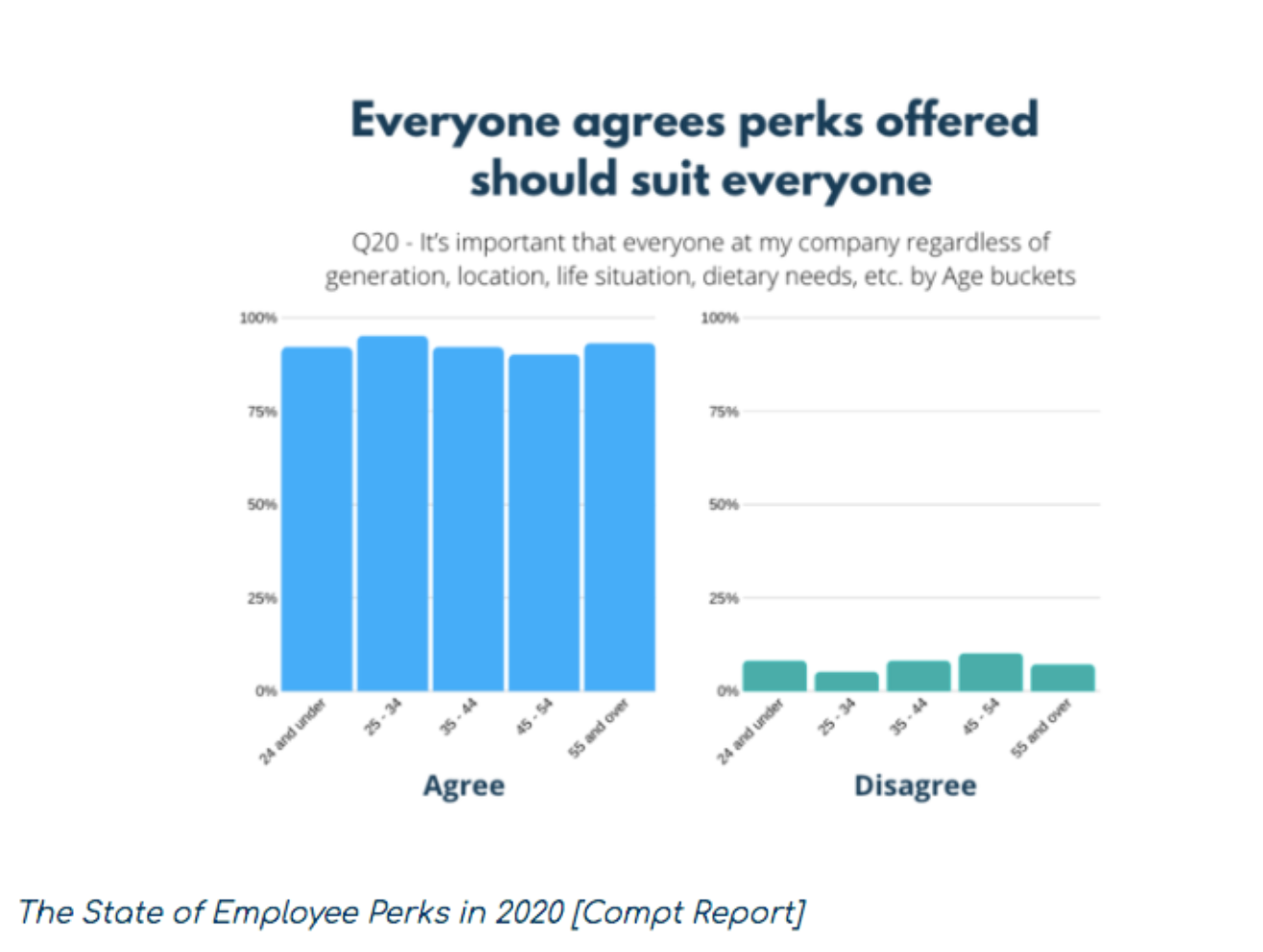
The benefits market is highly varied, and so are the employee groups who will use them. How do you build a tailored list of employee benefits—one that answers the needs of all sides?
Benefits more important than… a raise?
According to Harvard Business Review research, 80% of employees are willing to treat non-wage perks as an alternative to a raise. Just not all of them. Extra benefits make sense as long as they deliver tangible financial value and support what matters to us.
Work-life balance, for example. Less typical but more meaningful benefits include:
- psychological support,
- access to a company concierge,
- home-cleaning service as part of a cafeteria program,
- flexible benefits for employees with different needs (e.g., leaving early to pick up a child, or extra days off for a hospital visit with a loved one).
In short: it's about caring for the overall wellbeing of the person you employ. The whole thing can be summed up in one word: wellbeing.
Modern employee benefits — do they make sense from the employer's side?
More and more companies reach for non-wage perks deliberately. Is “low-budget employee benefits” an oxymoron?
The question is what's less of a burden on the budget: investing in a benefits offering, or losing talent and paying the costs of recruiting and onboarding?
The answer to employee needs won't be funding expensive training or the priciest health benefits on the market. Less commercial, more creative solutions (like the six above) can produce a “wow” effect too.
After all, motivation isn't about spending millions on gimmicky theme days—it's about making employees want to engage. And sometimes simply recognizing an employee with a certificate is the best form of reward.
What are the three types of organizations when it comes to motivating people?
There are two types of organizations. Those with a nice atmosphere that supports improving the “productive capacity of the human resource” (what an awful way to put it!), and those where something is happening—some attempts at finding ways to motivate—but no tailor has yet stitched together a strategy for building engagement and motivation.
There's also a third type. We're saving it for dessert.
We once rolled out a platform in the call/contact center of a large finance-and-insurance company. During one conversation, the topic of motivation came up. The dialogue with the director was short, and the only thing that isn't true in the exchange below is the name:
— So, how do you currently motivate your employees?
— I don't fire them.
As you can see, the feudal style of management is alive in some places and, surprisingly, holding up rather well. It's probably just a matter of time before employees start giving places like that a wide berth.
Benefits, recruiting, and onboarding — can you connect them?
You already know that extra employee benefits are one of the effective tools for making a company more attractive. In managing benefits, clearly informing employees about the offering plays an important role. It's worth supporting your people on their way to activating the perks they choose. That's how you build a consistent experience between the promises made during recruiting and what real day-to-day comfort at work looks like.
A Staples report found that as many as 62% of employees would accept lower pay in exchange for better benefits. Unfortunately, not every company takes advantage of that…
Modern employee benefits — in brief
- Benefits should support employee wellbeing (health, finances, work-life balance). Fonts can look nice in a job ad.
- The same benefits package won't work the same way for everyone; it's worth designing with different groups in mind (white collar, blue collar, new parents, caregivers of people with disabilities, and so on).
- Often the biggest effect comes from well-thought-out, low-budget benefits (flexibility, schedule priority, a parking spot, the Late-Start Pass).
- Technology (such as an onboarding app) helps communicate benefits well and make sure they're actually used.
Featured blog posts
Discover the most popular posts about employee onboarding and modern HR.


