
7 Business Benefits of Onboarding


When we talk about onboarding, we too often focus on its operational dimension - procedures, task lists, and "who should do what." We too rarely look at onboarding as an investment with a very concrete, measurable return. And that's a shame. A well-designed and automated onboarding process means not just less chaos, fewer emails, and less stress in the first weeks of work. Above all, it has a real impact on the business: lower employee turnover, a shorter time to independence, more productive teams, less burden on managers, and significant savings in recruitment and HR.
What's more, effective onboarding strengthens organizational culture, improves the employee experience, boosts engagement from day one, and helps build a predictable, scalable process that works just as well for a single hire as for hundreds a year. And that's only the beginning, because there are even more benefits. Want to see just how hard onboarding can work for your company's results? Let's dive deeper into the topic.
1. Onboarding reduces turnover
The employee signed the contract, HR closed the recruitment project, the employer can breathe a sigh of relief and wait for the new hire. Or can they?
In a study by Indeed, 28% of candidates admitted to a practice known as "employee ghosting." This refers to a situation in which employees vanish off the employer's radar before their first day of work. The candidate's contact with the employer breaks off during the recruitment process, or the new employee simply doesn't show up on day one despite accepting the offer - and even signing preliminary employment documents.
In the industry editions of our "Onboarding in Poland 2025" study, we asked whether participants had ever quit a job before their first day or failed to show up on day one without informing the employer. 14% of logistics workers, 19% of HoReCa workers, 9% of people in retail, and 8% of those in services answered yes. On average, 1 in 10 successfully completed hires can end in losing the employee before their first day of work.
How do you avoid situations like these? Above all, by implementing consistent, attentive communication in the period between recruitment and the first day of work. It's exactly this stage - often overlooked - that has the biggest influence on whether a newly hired person actually shows up at the company. Effective onboarding starts the moment recruitment ends, not on the day the contract is signed. That's when it's worth beginning to build the relationship, respond to the employee's needs, and address any doubts before they grow into a decision to back out.
But that's not all. An employee simply showing up on day one is only the beginning - and the first months are one of the most sensitive periods when it comes to turnover. After the initial excitement, doubts often appear, along with stress over the first tasks, a sense of being lost, or simply not knowing how to carry out new responsibilities. A newcomer's emotions and needs change from week to week, which is why it's so important not to leave them "to fend for themselves."
Regular one-on-one meetings with the manager, the steady availability of a buddy, and recurring pulse checks help catch the first signs of difficulty quickly and prevent them from escalating. All of this directly affects the early-turnover rate within the first 3 or 6 months. And we have proof! Decathlon - one of our clients - reduced early turnover from 44% to 34% in just one year after streamlining and automating its onboarding.
2. Automated onboarding saves money. A lot of money
Effective onboarding is a long-term process that involves many people and can't be done properly in a single day or even a week. A new employee needs at least three months to feel confident, understand the context of their role, and reach full independence. But such a long period also comes with concrete costs. Our calculations show that the cost of onboarding an employee equals seven average salaries - which means costs running into the tens of thousands.
Where do the high costs of onboarding come from? Contrary to appearances, not from tools or training materials, but above all from the working time of the people involved in the process: HR, managers, buddies, coworkers, administration, IT, compliance, and payroll. We estimate that hundreds of small, repetitive activities - reminders, setting up access, answering the same questions, tracking deadlines, collecting documents, or preparing onboarding plans - make up as much as 38% of the total cost of onboarding.
And if the process is weak? The risk of losing the new employee rises, which means a repeat of recruitment and another onboarding. The cost of acquiring an employee then grows exponentially.
That's why savings in onboarding don't come from shortening the process (because such a hasty move can drastically increase turnover), but from automating the most repetitive and time-consuming tasks.
Our experience shows that automation can:
- lower the cost of onboarding by up to 15%,
- cut the working time of people involved in onboarding by as much as 40%,
- while at the same time maintaining a high standard of employee experience.
The system handles what's repetitive. People handle what really matters - they support, explain, and build relationships. And it's exactly this part that determines the effectiveness of onboarding and increases the chances of keeping the new person in the organization.
3. Onboarding raises the productivity of entire teams
The goal of onboarding is to bring a new employee to full productivity as quickly as possible. Data from SHRM shows that people who went through a well-designed onboarding achieve up to 50% higher effectiveness. Our own analyses, in turn, show that employees using the Gamfi onboarding tool ramp up 21% faster, and their engagement rises by 71%.
Effective onboarding, however, affects not only the individual but the whole team. The faster a new person becomes independent, the less burden falls on their coworkers. A poor onboarding weakens morale, because the team has to compensate for the new person's inefficiency for weeks (and sometimes months) - often through no fault of their own. Good onboarding restores balance: everyone can focus on their own work, and the new employee becomes real support rather than a burden much sooner.
4. Well-organized onboarding frees up managers' time
Our previously cited "Onboarding in Poland 2025" report shows that as many as 52% of Polish employees were onboarded without any manager involvement. What's more, 27% of those surveyed emphasize that during onboarding they lacked role-specific onboarding - an introduction to the role and scope of duties that is the direct manager's responsibility.
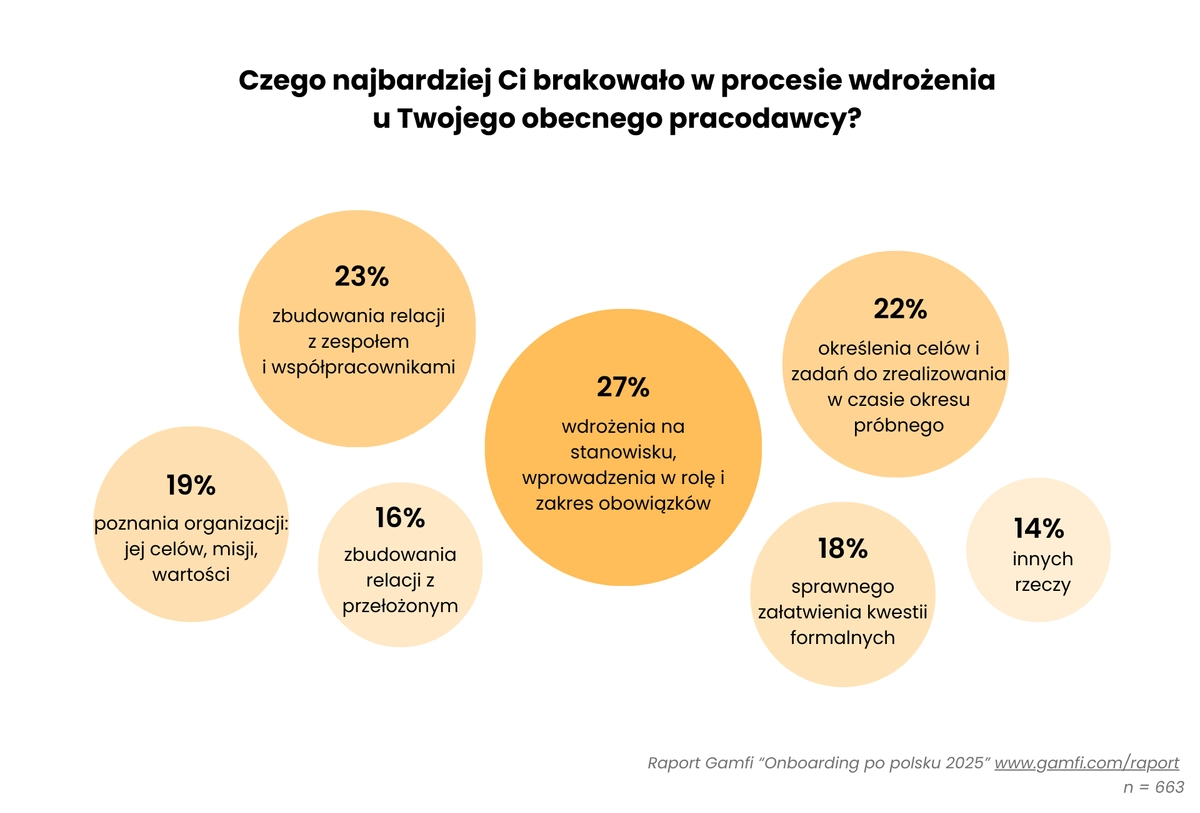
Why does this happen? The cause is manager overload. Their standard responsibilities are very demanding, and onboarding a new person means extra tasks. As a result, managers are overwhelmed by an excess of things to do. They have time neither for genuine substantive onboarding nor for building a relationship with the new employee - even though they know they should do all of this. In such a situation, despite the best intentions, effective onboarding with the manager's involvement is hard to achieve.
A manager's onboarding problems:
- no time, because they focus on business goals,
- frustration, because operational matters land on them (equipment, health and safety, the contract, etc.),
- actions on their side add no value, because they're routine,
- they can't focus on building the relationship and passing on practical know-how,
- they lack tools to scale onboarding - hiring 4 people means doing the same thing 4 times,
- they need someone ready right away, while effectively onboarding an employee takes weeks or months.
To change this, it's worth reaching for technology solutions that relieve managers of repetitive, operational tasks. By automating processes such as ordering equipment or filling out HR questionnaires, the manager can devote more time to role-specific onboarding. Our experience shows that a tool that automates onboarding can save up to 40% of managers' and HR staff's time.
5. Onboarding optimizes recruitment costs
Does changing a candidate's status in the ATS to "hired" end the recruitment? Not quite. That's just a formality.
The real success of recruitment isn't signing the contract, but the candidate showing up for work on day one and staying with the organization after the probation period. Two metrics - the show-up rate (the share of people who actually turn up on day one) and the probation completion rate (the share of those who successfully finish the probation period) - most accurately show whether a real "match" occurred between the company and the candidate.
Without well-planned onboarding, both of these metrics drop. And then the risk grows that new talent will part ways with the organization before they even properly get started. In practice, this means having to repeat the recruitment, re-engage HR and management teams, and double the cost of acquiring an employee.
There's no good recruitment without good onboarding. Only the combination of these two processes guarantees that the candidate not only shows up on day one but also stays with the company longer than a few weeks - and that's exactly the measure of recruitment success.
6. Onboarding builds great teams for years to come
In the long run, proper onboarding is a solid foundation for the entire team. By giving a new person a valuable onboarding, we take care not only of them but also of the comfort of the rest of the staff. Structured onboarding later means better communication among the people employed at our company. Thanks to consistent knowledge about the organization, projects, and clients, it's easier to build a cohesive team. A newcomer equipped with the right support and knowledge feels more confident in their role and, as a result, supports the rest of the crew in delivering shared business goals sooner. The team, in turn, knows they can rely on them and share responsibilities with them. As a result, we employ people who trust one another's competencies and can work together for years like a well-oiled machine, without a thought of changing jobs.
According to a study by Brandon Hall Group, companies that invested in effective onboarding saw employee retention rise by 82%.
7. Onboarding strengthens employer branding
There are no effective employer branding efforts without genuine ambassadors inside the organization. By building a positive employee experience, starting from the recruitment and onboarding stage, we also take care of the company's image as an employer. Valuable onboarding can be seen as an additional benefit and can have a positive effect on the employee referral program.
According to data from CandE Global Research Reports, new employees' willingness to recommend an employer rises by as much as 93% if they were provided with proper preboarding. What's more, even a single phone call with the manager before the first day of work makes their inclination to recommend the new organization rise by 83%.
Onboarding is, in a way, an extension of recruitment - the time when candidate experience flows smoothly into employee experience. A proper onboarding process cements the employee's conviction that the promises the employer made during recruitment hold true in reality. There's probably no sturdier foundation for building loyalty at the start of a working relationship.
Summary: onboarding is one of the smartest investments in your business
Onboarding is sometimes seen as a set of formalities or an "HR obligation" to be checked off. Yet all the data, examples, and metrics show something different: it's one of the most influential processes in the entire organization. It determines turnover, the cost of acquiring employees, team productivity, managers' time, people's morale, the quality of collaboration, and the strength of the employer brand.
It's onboarding - not recruitment alone - that decides whether talent stays with the company or leaves. Whether the team will work like a well-coordinated crew or struggle for months with onboarding gaps. Whether the company will bear the costs of chaos or gain an advantage thanks to an organized, scalable process. The good news? Most of these effects can be achieved faster, cheaper, and more predictably through automation.
Onboarding tools take over what's repetitive and time-consuming, leaving people the space for what truly determines success - relationships, communication, and real support for the new employee. And organizations that treat onboarding as an investment rather than a cost gain the most important thing: stable, engaged teams and employees who want to stay for years.
Featured blog posts
Discover the most popular posts about employee onboarding and modern HR.


