
Onboarding Roles: Who Owns Employee Onboarding?


"You must gather your party before venturing forth," the narrator famously intones in the cult fantasy game Baldur's Gate. And while onboarding isn't a battle against wizards, it does call on many people and departments across an organization. Today we'll show you how to account for specific roles in onboarding and manage the whole process so that real magic happens.
The onboarding dream team: onboarding is a team sport
Say "onboarding," think "team." Why? Because comprehensive onboarding has to address the needs of both the employee and the employer on several levels. That, in turn, calls for the involvement of many departments and people across the organization, from personnel administration and HR to the manager and buddy, all the way to facilities, IT, the training team, and compliance. Their efforts may overlap and intersect, but every member of the team should be working toward one shared goal: getting the new person ready to perform at full capacity.
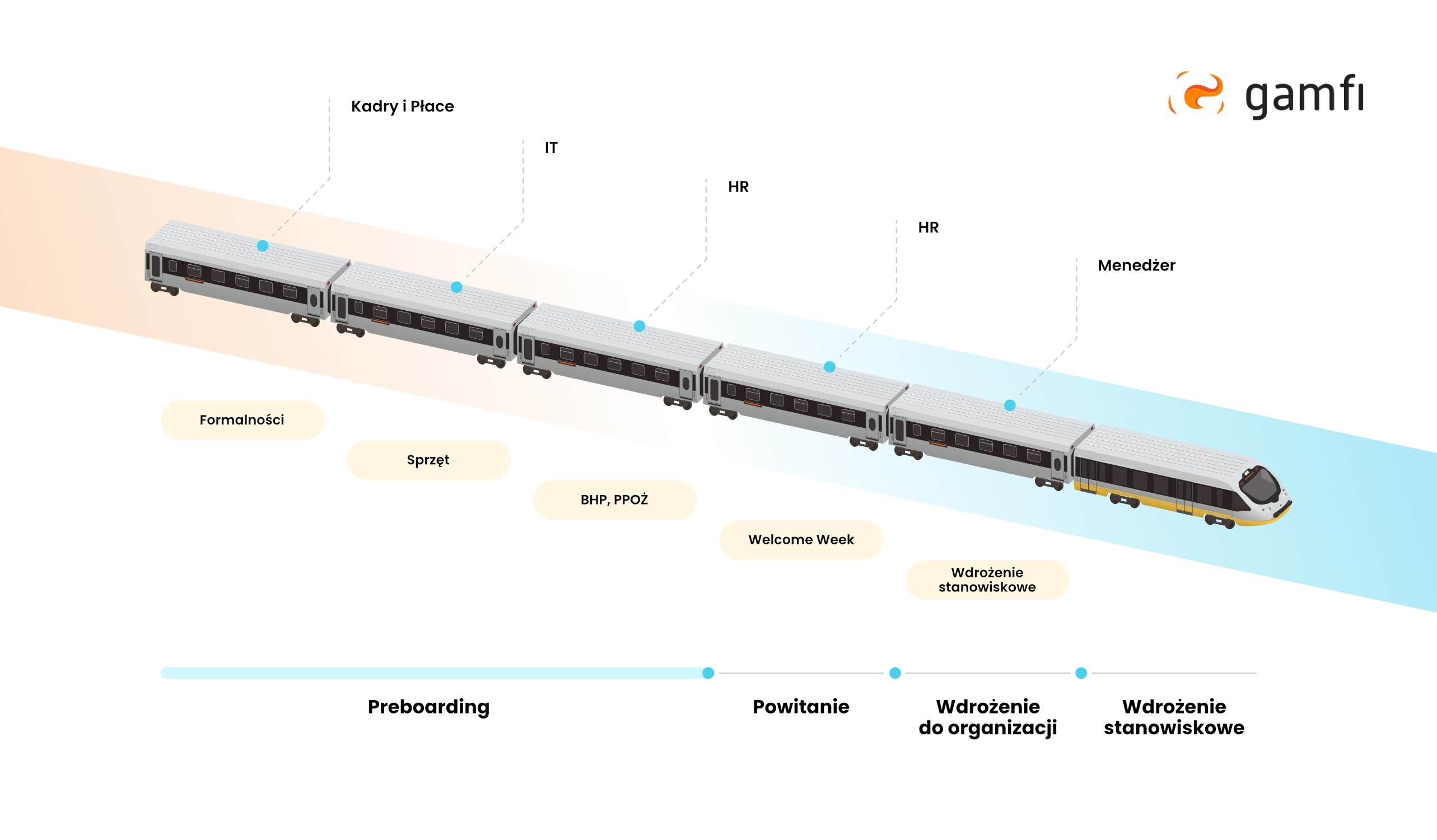
Employee onboarding is very much a team sport, where working across processes is key. But for everything to run like clockwork, you need a coherent plan of action, one that structures every area and task and anchors them in clear timeframes.
Just as you can't complete the entire onboarding process on a new hire's first day, the HR team alone can't meet all of a new employee's needs. Only when many people pull together in a coordinated way can that onboarding magic happen.
All right, then. Let's take a look at the individual players in our onboarding troupe.
Onboarding roles: payroll and personnel administration
Perspective and goal
The goal here is simple: handle the paperwork. Payroll and personnel administration need to collect the necessary data, documents, and certificates from the new employee to complete all the formalities tied to their employment. From their perspective, what matters most is complete documents and accurate data, and it all has to happen in line with GDPR.
Where personnel admin gets stuck in onboarding
Collecting data and all the documents can be a long, tedious process. One error in a personal questionnaire and the employee has to fill it out again, which drags the whole procedure out. On top of that, the documents that reach the team aren't always complete, and the first day is fast approaching. Time pressure builds, and in those conditions, mistakes are easier to make.
And once everything finally comes together and the employee's personnel file is ready, the necessary information still has to be entered manually into the company HRM system… That's extra work, and it isn't error-free either.
How to support payroll and personnel admin in onboarding?
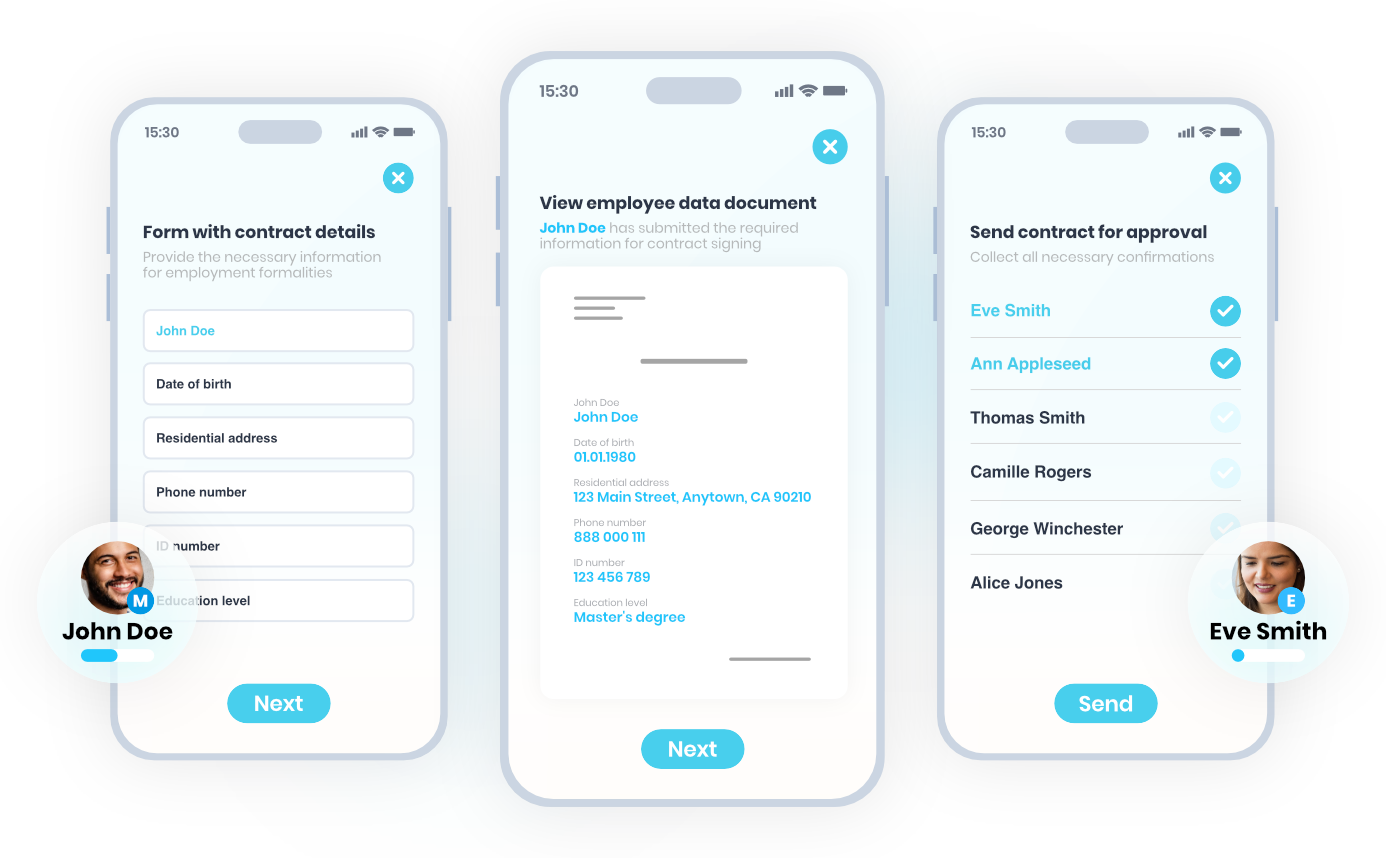
The more hires and the more manual data entry that comes with them, the greater the risk of error. To minimize it, the whole document-gathering process is worth automating and digitizing, for example through a dedicated app. Replacing paper forms and scanned documents with a tool where the employee fills out a form and the data flows onward along a defined path makes the process faster and easier.
Onboarding roles: IT
Perspective and goal
The IT team's job is to equip the new employee with the hardware and access they need, often at the manager's request. Sometimes they also walk the new hire through their first system login and device setup.
Where IT gets stuck in onboarding
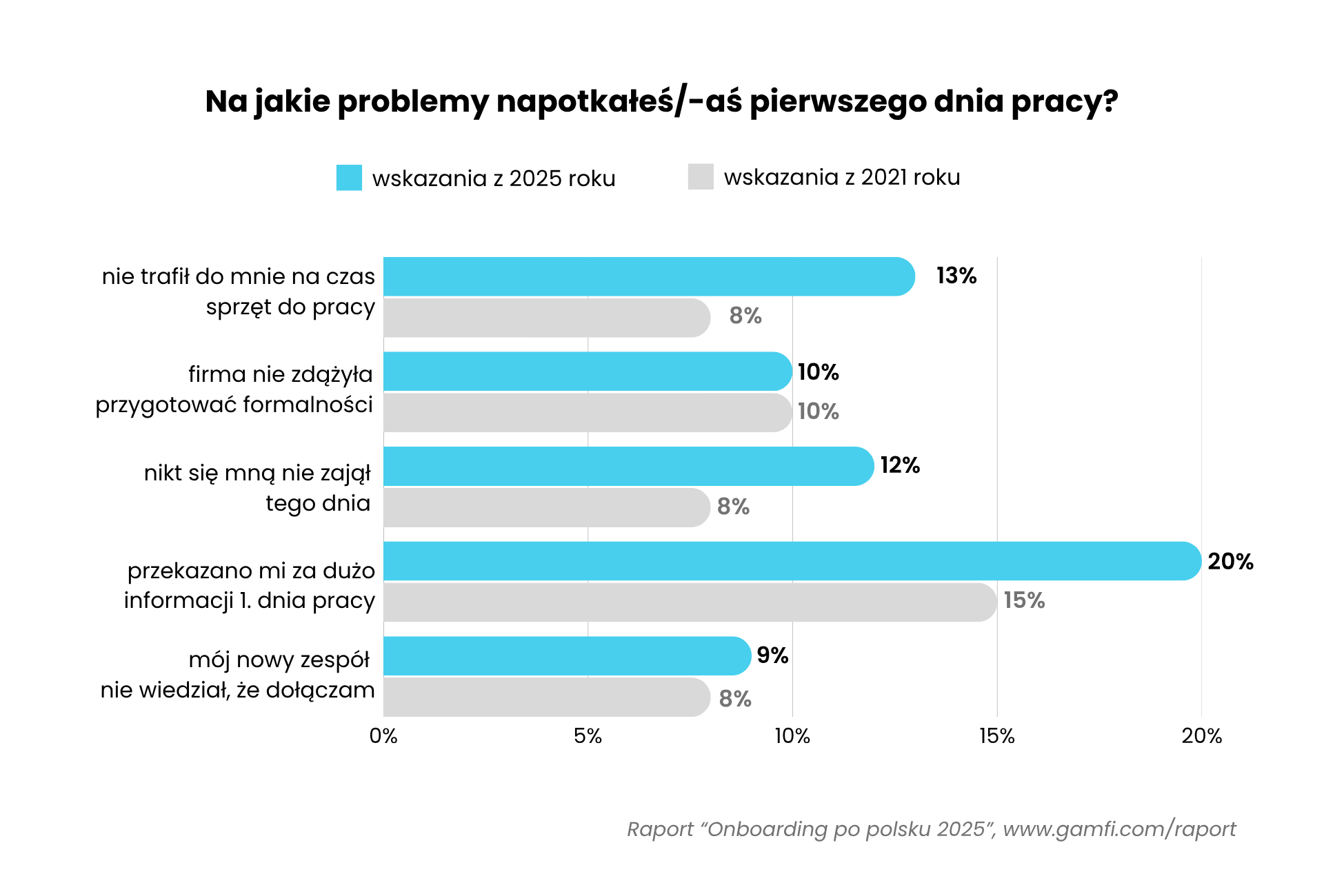
Preparing equipment, configuring it, granting access, you'd think… routine. Not quite, especially when requests reach IT through different channels (email, chat, even in person), and some need to be handled on the spot because the new employee is already sitting at their desk waiting for a computer… In short: the lack of a clear path or procedure for managers and HR around the technical setup for new hires can seriously complicate daily life on the IT team. It's hard to plan and coordinate a department's work around requests that come in ad hoc, sometimes incomplete, and with varying deadlines. That definitely doesn't sound like routine, more like a recipe for frustration. The data from our report "Onboarding in Poland 2025" backs this up: equipment not being ready on time is the second most frequently cited pain point among employees, experienced by as many as 12% of Polish workers.
How to support IT in onboarding?
Probably no one knows the power of process automation better than an IT professional. Even something as seemingly trivial as ordering equipment can be streamlined. By rolling out a tool that automatically sends the order from the manager, HR, or even directly from the employee, you get a single communication channel for everyone.
Onboarding roles: HR
Perspective and goal
Changing a candidate's status to "hired" in the ATS is, from the HR team's point of view, the crowning moment of the recruitment process. They found and hired a new employee, so the main goal is achieved. At the same time, a new chapter in communicating with the newcomer begins: the onboarding process.
Sending the welcome pack, running welcome week, and delivering the basic training are usually the next steps HR specialists take. All of it to prepare the new person for role-specific training and hand them off to the manager. Is that where HR's job in onboarding ends? We'd add one more goal: supporting the manager in onboarding the employee into their new responsibilities.
Where HR gets stuck in onboarding
HR puts an enormous amount of work into recruiting, so every hire is a big win for them. For the manager, in turn, the win is when the newcomer becomes self-sufficient in their role and starts supporting the team with their experience and skills. Instead of playing toward the same goal, sometimes that difference in perspective complicates communication between HR and the manager. Each works to their own rhythm, when the point is to keep pace with each other as partners throughout onboarding.
How to support HR in onboarding?
A huge help for HR will certainly be smoother communication with the manager around the (fair) division of duties and a shared push toward the onboarding goal. How do you do it? Start at the beginning: map the entire process, check what each side needs, and reach for a tool that answers those needs. A shared communication channel on Slack or another messenger is an essential step for a company just taking its first steps in onboarding. The next is rolling out an onboarding app that "assigns" successive tasks to HR and the hiring manager exactly when it's time to act on them.
Onboarding roles: the manager
Perspective and goal
From the manager's perspective, effective onboarding should equip the employee with the knowledge and skills to independently hit the targets set for them. In a word, it's about preparing the new person to support the team's business work at the same level as everyone else.
Where the manager gets stuck in onboarding
Managers usually want to help a new employee settle into the role. But onboarding isn't their only job, and very often it isn't even treated as a job. There's a client to serve, a project to close, KPIs to prepare, a meeting with IT, an equipment order to place… In all of that, the new team member is a bit like a passenger who's just boarded a speeding train, with no idea where to sit.
The pileup of tasks a manager handles day to day means that the role-specific onboarding they're responsible for becomes a bottleneck. The previously cited "Onboarding in Poland 2025" report shows that:
- 27% of Polish employees went through no role-specific onboarding at all,
- 52% never met their direct manager during onboarding,
- 12% had no one looking after them on their first day,
How to support the manager in onboarding?
The biggest help for a manager is taking operational work off their plate and removing repetitive tasks. You can do this by:
- giving them a checklist, or a checklist-based app, that automatically reminds them of the next steps and actions at each stage of onboarding,
- automating administrative tasks (requesting the hire, equipment, or workwear, asking for access to be granted, and so on),
- building their knowledge and skills around effectively onboarding an employee into the organization and the team.
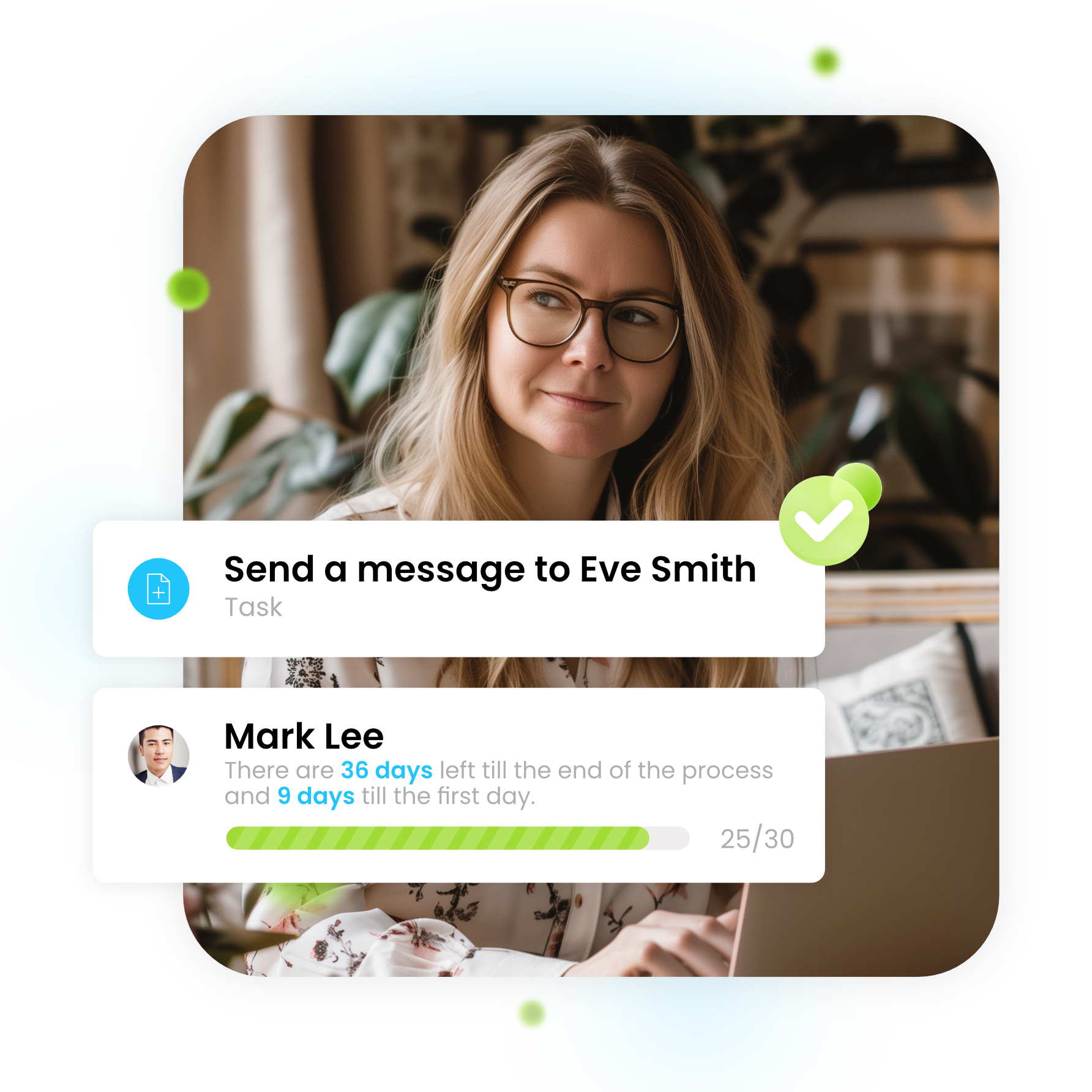
With solutions like these, the manager gains more time for quality role-specific onboarding, equipping the employee with the knowledge they need to reach full productivity fast.
Onboarding roles: the buddy
The buddy's perspective and goal
The buddy who accompanies a new person through their first weeks has a crucial impact on how quickly the employee finds their footing in the new organization. Unfortunately, this area is often downplayed, which is a shame, because without good relationships with the team and the know-how (both the official kind and the behind-the-scenes kind) of how to navigate the organization's structures, you can't work effectively. The buddy is a sort of "pal" who accompanies the new employee through the whole onboarding process. They're the link in communication with the manager, help the newcomer adapt to the team, and share their insider knowledge. In a word, the new hire gains a guide to the organization's pathways. Sounds like quite a bit of work.
Where the buddy gets stuck in onboarding
One of the buddy's problems can be reconciling their current duties with looking after the new employee. Is a shared lunch, an office tour, and good advice when needed enough? Or do they also need to talk through current projects and clients? How do you live up to a new role when it's unclear what it actually involves? When no one has defined the scope of responsibility and the timeframe over which the new crew member can count on their guide's support, confusion and frustration can start to take root on both sides.
How to support the buddy in onboarding?
The cure for the buddy's troubles is certainly an onboarding plan built together with the manager. Clearly defined tasks broken into stages bring order to the whole process and focus the effort on specific areas. With something like a checklist on hand, it's easier to concentrate on supporting the new employee and weave daily tasks in between shared meetings. But if the workload gets too heavy, encourage the buddy to involve other team members in onboarding. It's enough for two or three additional people to explain the company structure or show the new person how to use shared drives, and then go grab a coffee together. That helps break the ice and, further down the line, makes building relationships on both sides easier. The new employee sees that everyone works as one team, and the buddy feels they have support within the team.
The buddy's satisfaction
Once they reach the finish line, a reward should be waiting for the buddy. It could be an extra perk, a piece of swag created just for people in this role, or simply words of thanks. Let's recognize their work and their commitment to looking after a new colleague. Let's show that we don't downplay this role and that, in the context of the whole onboarding process, it's just as important as the others. After all, the buddy is an informal company ambassador. They don't share their opinion of the organization as part of employer branding; they pass it on naturally to the newcomer, for example over coffee in the office kitchen. Let's make sure they feel good in our ranks too.
Last but not least: the employee's perspective
The perspective of an employee stepping into a new work environment is highly dynamic, and their onboarding needs evolve over time. From the moment recruitment wraps up successfully, they feel a swirl of emotions, from stress and uncertainty to excitement and motivation to perform in the role. The challenge is to sustain the new person's engagement while easing their discomfort.
From the start, in small steps and… in portions
By building a relationship with the new hire as early as the preboarding stage, we have a chance to ease their discomfort and stress. So let's give them a solid knowledge base about the company and the role itself. The right kind, where knowledge is doled out in small portions, matched to what the employee needs at a given moment in onboarding. The point is to keep pace with the employee, not overwhelm them with the entire process at once.
The power of habits
According to HR expert Maja Gojtowska, effective onboarding for a new employee is about building the habits needed and useful for functioning in the new organization. Those habits span many areas: from the strictly operational, tied to the new role, through work culture, to the less formal customs within the team. A welcome day, or even a welcome week, isn't enough for new habits to take hold. According to a study by Phillippa Lally and her team at University College London, it takes an average of 66 days to act on a new habit automatically. That's when we start doing certain things naturally and instinctively.
Translating that to the professional realm, we can conclude that only after that much time does a new employee gain the resources to start working independently and reach full productivity. And that's exactly the goal of onboarding!
So the seams don't show. On a coherent onboarding experience
Effective onboarding is highly complex and involves many stakeholders within the organization. Each person or department engaged in the process owns a different area, which means responsibility for onboarding is distributed. There's nothing wrong with that. What matters, though, is that from the employee's point of view the whole process is one coherent experience.
Manually filling out documents for payroll, then an in-person visit to IT to pick up equipment, followed by basic training online, that is definitely not a coherent onboarding experience. Why? Because it exposes too much of the "onboarding kitchen" and forces the employee to adapt to how each department works.
Far friendlier is a single tool where the new hire can move through the entire process step by step. The point is to give the employee a solution that ties all onboarding stages into one and streamlines communication. For example, we give the new person an interface where they can fill out the necessary documents, pick workwear in the right size or work equipment, and go through a cycle of training, all at once. Payroll and personnel admin get the data exported to a PDF or the HRM system, IT receives the request to prepare equipment, and HR can track training progress. A solution like this not only improves the new person's experience but also streamlines the daily work of many roles in the organization, genuinely cutting the time they spend handling the onboarding process.
Featured blog posts
Discover the most popular posts about employee onboarding and modern HR.


