
Who Should Train a New Employee: Manager, Buddy, or HR?

The manager should be the guide through a new hire's onboarding, HR the support, and the buddy, IT, and admin the essential finishing touches. In practice, though, the line "hey, a new person is starting tomorrow—can someone take care of them?" sounds uncomfortably familiar. At half of all companies, a person in a new role never meets their manager during onboarding, and the onboarding itself is a grab-bag of ad-hoc actions. Let's bring some order to it: we'll walk through when the manager, buddy, HR, IT, and admin should each step onto the onboarding stage. Shall we begin?
Employee onboarding: a fixed script, but different actors
You can think of onboarding as a script with many roles, each carrying a different responsibility and a different cue to enter. In most companies, though, it's improvisation without a script (and few people have a real talent for that). One person handles access, another gives the tour, a third runs the on-the-job instruction and delivers the training—and nobody ties it all into a single process.
Our report "Onboarding in Poland 2025" shows that anywhere from one to several people take part in onboarding a new hire, yet they rarely work to a shared plan. The manager (present in 48% of onboarding processes) most often owns goals and first tasks, the buddy or designated colleague (present in 28% of the cases we studied) supports the day-to-day, and HR (11% of onboardings) handles organizational and formal matters.
The thing is, effective onboarding starts with a plan—from the moment the offer is accepted through the end of the probation period. A good onboarding process for a company's new employees should cover:
- Pre-onboarding (days -7 to 0)—preparing the workstation, access, and materials,
- The first day and week—a welcome from the leader, introducing the new hire to the team, on-the-job instruction, and kicking off the first tasks.
- The first 30–90 days—delivering the goals set for this stage of probation, plus feedback sessions.
It's precisely by combining these elements that onboarding becomes a repeatable, measurable experience that genuinely moves the company's results (an onboarding survey is a good way to base what you know on facts).
Onboarding is a team sport, but it won't work without a captain
In theory, we all know onboarding is a team process. Running an employee's training solo is possible, but hard. According to our report "Onboarding in Poland 2025," only 48% of new hires met their direct manager during onboarding. That means in more than half of cases, the leader's role simply vanishes from the game. And when the captain disappears, even the best team struggles to win.
A missing manager in the onboarding process is a business risk—and no, we're not exaggerating. In the first weeks, onboarding should make clear who is meant to teach the employee the job, what their priorities are, who they'll work closely with and why, and what their role is in the team's and the company's success. Without that, a new hire's adaptation gets harder. You'd probably agree it's better to know your goals sooner than at the annual review, right?
Where the manager actively takes part in onboarding (scheduling 1:1s, discussing 30/60/90-day goals, giving quick feedback), the new person reaches independence and confidence faster. So while we're about to walk through the roles different people play in different onboarding processes, the manager's presence should be the constant denominator.
The manager—the start, the goals, and the standards
Too often the manager's involvement is limited to a handshake on day one. When instead, they could be handing over the new hire's actual responsibilities…
And yet leaders in an organization have a hugely important job: they ground company goals in the everyday context of employees, they're catalysts of organizational culture, and it's thanks to them that the "vision and mission" come to life rather than staying printed on the wall above reception.
Or at least, that's how it should be.
When a manager actively leads onboarding, the new person reaches independence and confidence faster, and new hires' effectiveness rises in the very first weeks (and after all, that's why you hired them, right?). When managers actively engage in onboarding, employees are 3.4 times more likely to agree that the onboarding process was exceptional. We didn't make that up. That's Gallup ("Creating an Exceptional Onboarding Journey for New Employees," p. 17).
The manager's tasks during onboarding
- Before the start date—prepares 30/60/90-day goals and sets success criteria. Makes sure the workstation is ready and plans conversations with key people.
- On the first day and week—personally welcomes the new hire, explains how the team works, and goes over the rules of collaboration and expectations for the role.
- In the following weeks—runs regular 1:1s, gives and asks for feedback, monitors progress, and adjusts the onboarding plan when needed.
Context, priorities, and the pace of development are the manager's responsibility, not HR's. HR can create the framework, the materials, and the automation, but without an active leader, onboarding new employees loses coherence. And meaning.
The "employee trains employee" approach—when it works, when it hurts, and the employer's obligations
Our own report mentioned above shows that 28% of employees were onboarded by their direct colleagues, often without a plan or support from a leader. In one in three organizations, onboarding new employees is left to chance!
Don't get us wrong. A situation where one employee trains another can be a huge asset—as long as it's deliberately planned. In the best organizations, this model works as On-the-Job Training (OJT). But then the colleague isn't a "stand-in manager"—they're a workplace trainer who shows the standards, explains the context, supports the first tasks, and confirms readiness for independent work. Experienced employees are usually best suited to delivering this kind of instruction.
The problem starts when that on-the-job instruction happens ad hoc. A colleague who doesn't know what to convey or how to assess progress teaches "their own way." Under those conditions, a standard is just a word. And without standardization, is safe work even achievable?
How do you plan an "employee trains employee" process? Proper on-the-job instruction
Any organization using the "employee trains employee" model should put three principles in place:
- Set the goal—what needs to be conveyed, why, and in what order (work organization, tools, safety standards—this isn't optional; in many jurisdictions the employer is legally required to do it).
- A simple OJT plan—an on-the-job instruction sheet listing the topics, with space for the new hire to confirm completion, especially around safe ways of working.
- Preparing the trainer—training for the people who deliver on-the-job instruction, where they learn how to teach, how to check that knowledge has stuck, and how to give feedback.
A well-planned "employee trains employee" model supports integration, strengthens a culture of collaboration, encourages safe ways of working, and shortens a new hire's adaptation. A poorly planned one means the new person learns standards that aren't necessarily correct—or even picks up unsafe habits. There's a reason role-specific onboarding is called the hardest stage of onboarding.
Who delivers the instruction? Safe work for the employee
On-the-job instruction is delivered by the employee's direct manager or by experienced colleagues designated by the employer who have the right qualifications to teach the job. The goal: training on working conditions, hazards, and the rules for performing duties safely. Confirmation that the instruction took place and that the employee was familiarized with the rules comes from the signatures of the participant and the person delivering the instruction on the initial health-and-safety (OHS) training record. (Exact documentation requirements vary by country, so check your local labor regulations.)
The buddy—onboarding the new hire into the culture and the everyday
Let's run a little test. Who should an employee be able to turn to with questions like: "Who do I log my vacation with?", "Where do I find the brief template?", "Can I just message the director on Teams?" Usually they go to the first person they happened to meet and clicked with. So what if we made that easier?
Enter the buddy—the new hire's guide, an informal navigator through the organization's culture, relationships, and daily rituals. The role of a buddy or designated colleague appears in 28% of the cases we studied, and in large organizations (1,000+ employees) it's already 38%.
Since the practice of assigning a buddy is still used by a minority, let us briefly explain: the buddy's job is to help the new hire find their feet in the company's culture and its informal rules. They're a mentor for company know-how who can pass on knowledge without stress or formality.
How do you plan the buddy's role?
- Choose the right person—not everyone is cut out to be a buddy, and not everyone who is has the knowledge and the time. Ideally it's someone who likes helping, has what it takes to mentor others, knows the organization, and communicates clearly.
- Account for their availability—assume it should be at least 15–30 minutes a day for the first week, then check-ins every few days. And don't forget to clear the time commitment with the buddy's manager.
- Prepare the buddy for the role—the buddy should know ahead of time that they're about to train a new hire; they'll probably have questions, perhaps beyond the material you've prepared. That preparation is exactly what sets the buddy role apart from improvised, on-the-fly support—and it matters a lot!

- Define the scope they're needed for—daily support on practical matters (tools, procedures, people), shared lunches, introducing the team, and reminders about safety rules and good practices.
- Don't forget feedback—a joint 30-day wrap-up works well, with a conversation about what went well and what needs clarifying.
- Show appreciation—being a buddy is an important role for onboarding, sometimes even a critical one. It takes real commitment, and that's worth recognizing and rewarding—for example with an extra perk (a bonus, a voucher, an extra day off—the options are genuinely wide).
The HR team designs, measures, and safeguards the onboarding standard
If we stick with the idea that onboarding is like a stage production, then HR should be its director—making sure everyone knows when to step onstage and what to do once they're there.
"Onboarding in Poland 2025" shows that the HR team takes part in the onboarding process in just 11% of cases. But note: that's how often participants in the study met an HR representative directly—it doesn't mean HR wasn't in the process at all.
HR's areas of action in onboarding
- HR creates a coherent onboarding script—from pre-onboarding through the first 90 days. It owns the schedule, materials, checklists, and tools (e.g. onboarding platforms).
- HR also sets the minimum onboarding standard—for example mandatory on-the-job instruction, OHS training, a 1:1 with the manager, and a cycle of feedback conversations. That way every onboarding process, regardless of department, meets the same quality and safety criteria.
- Measurement and improvement—HR monitors metrics like time-to-productivity, probation-period turnover, and the new hire's NPS. It analyzes the data, identifies bottlenecks, and rolls out improvements.
The manager leads, the workplace buddy supports, qualified colleagues deliver the on-the-job instruction—but it's HR that builds the framework tying their efforts into a coherent onboarding.
The first day in a new job—these aren't extras! Who else to keep in mind?
IT, admin, and finance teams—though they're often not the first thing that comes to mind with onboarding—frequently decide whether a new hire's first day is stress-free or chaotic.
Every onboarding begins with emotions, relationships, and organizational culture, but it comes down to whether the new employee can do their job safely and correctly. And whether that happens depends on a few more people making sure they have the tools to do it.

In our study, respondents repeatedly pointed out that delays in delivering equipment, access, or administrative information significantly affected their first impressions of the company. No laptop, no access card, no system accounts, or not knowing how to account for the first day at work can effectively wreck a good welcome. And let's not forget that the employer is obliged to provide the employee with tools—just as it must provide OHS training.
One last tip: how to prepare every role to onboard a new hire?
Putting together a starter kit is a good idea, because if onboarding is going to work, it has to be:
- repeatable,
- predictable,
- measurable,
and every role has to know what its task is and how to get through it.
Since you're here, we hope yours already is—but we suspect you're looking for areas to improve. In our view, every role deserves a handbook or starter pack with the information on what to do in the first days, weeks, and months of onboarding new employees.
What might such a starter kit look like?
1. For the manager
- a 30/60/90-day 1:1 plan
- a "goal and expectations for the role" card
- a template welcome message to the team
- a checklist of tasks before the start date (arranging equipment, access, a schedule of meetings)
2. For the buddy
- a "first 10 questions in a new workplace" list
- a map of the organization and communication channels
- sample ideas for informal get-togethers
- a short check-in card (day 1, 7, 30)
3. For the person delivering on-the-job instruction
- an On-the-Job Training (OJT) card (list of topics to cover, confirmation of completion)
- training/tips on how to give feedback and check understanding
- a list of critical mistakes and standard "do/don't" practices
4. HR—process architect and quality guardian
- a RACI matrix: who's responsible for what in onboarding
- a communication schedule (pre-onboarding, first day, 30/60/90 days)
- message and reminder templates
- a dashboard to monitor progress (e.g. task statuses, the new hire's NPS)
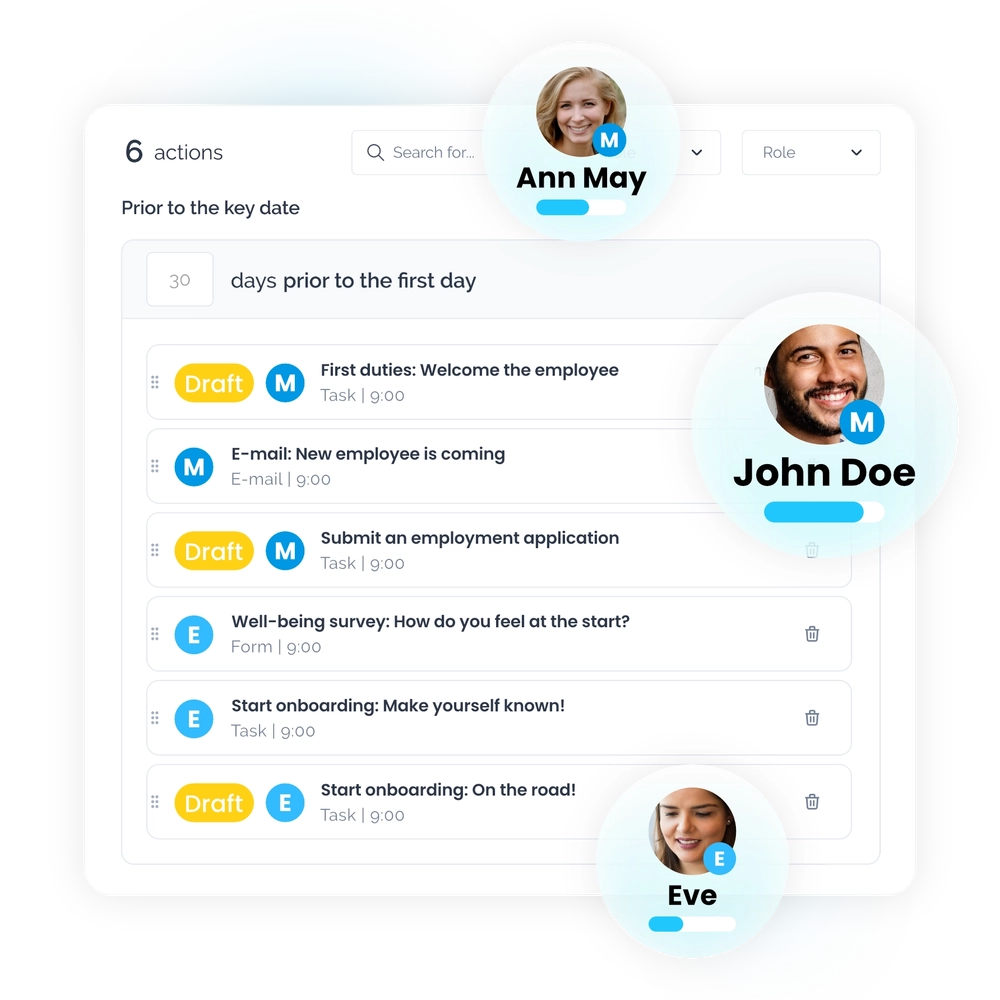
Finally, some good news. You can replace manually prepared and distributed starter kits for each role with a single onboarding app. With Gamfi you'll build an onboarding workflow for new hires that automatically—without any involvement on your part—sends instructions about upcoming tasks and checks the status of the whole process. See it for yourself (and on your own organization!).
Featured blog posts
Discover the most popular posts about employee onboarding and modern HR.


