Decathlon in Poland
Decathlon is an international chain of large-format sports stores that employs more than 3400 people in Poland. The great majority of them are young, from generation Z. More than 70% of everyone employed works in 64 stores spread across Poland, and 58% work as sports advisers, giving expert support to customers. Everyone employed in that role is an amateur or a professional sportsperson, which builds the unique organisational culture of Decathlon.
The challenge in onboarding
The spread-out structure of Decathlon had a direct effect on how new people were onboarded. Its shape depended on the individual store manager, who designed the process as they saw fit. The basis for defining onboarding tasks was an Excel file created years earlier and passed around the organisation with a list of tasks to complete. A process run that way had no single standard, so there was no way to control or measure it. With the sheer volume of day-to-day work on the shoulders of store managers, the process kept losing priority. All of this showed up in early turnover - 44% of new hires, including seasonal staff, were deciding to leave within 6 months. Among the three reasons for leaving given most often in exit interviews were a lack of recognition from the manager or the company, no sense of purpose and a poor relationship with the supervisor. Next on the list, leavers pointed to poor onboarding into the role and a lack of relationships with other employees.
Talking directly with the people who were leaving showed us the real reasons for their decision, completely different from the ones their supervisors expected. Those supervisors almost unanimously pointed to pay being too low; it turned out that almost every reason for leaving can be fixed with good onboarding.
The case put to the board
The HR team led by Joanna Brejta-Maciocha, HR Director at Decathlon, converted the early turnover figures into the financial losses the organisation was taking. The next step was to work out the savings that better onboarding would bring and to set specific business targets for the project. Among them were bringing turnover in the first 6 months down to 35%, improving sales conversion in the stores by 1 percentage point and improving the customer satisfaction score (measured with NPS).

In our conversations with the board, the key was to show the potential savings and gains that better onboarding would bring. The logic was simple: a well-onboarded employee will want to stay with us longer and will get to a high standard of customer service faster, and that service is critical at Decathlon. In retail this is easy to convert into money, and we used those calculations to convince the board to invest in onboarding.
Criteria for choosing a solution to support onboarding
The strategic principles of HR at Decathlon include data-based partnership with the business and the use of useful, user-friendly HR apps. That meant one thing: the new onboarding had to use a dedicated tool that would make the whole process measurable.
The HR team set 4 requirements for the solution it was looking for:
- modernity, which will mean Excel stops being an onboarding tool once and for all,
- flexibility, letting processes be matched to how the company works, without the supplier of the tool imposing a fixed process framework,
- support before and after the rollout, with no delays caused by time zones among other things, which meant choosing a local tool, built and developed in Poland,
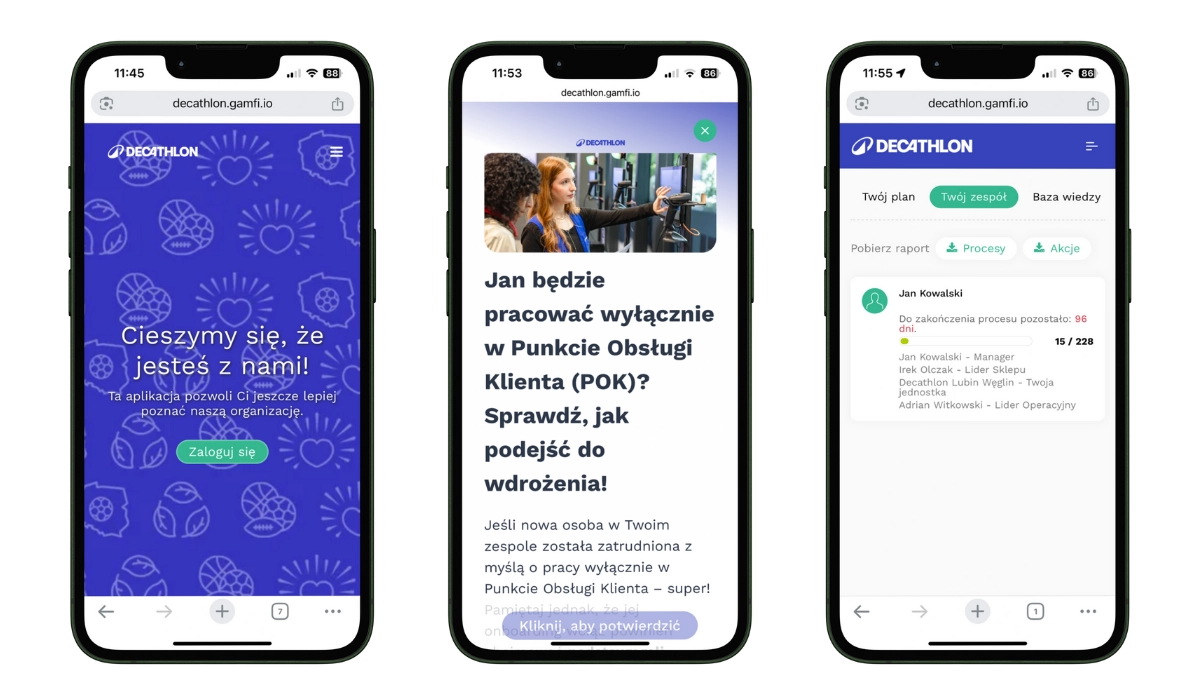
- simplicity, which lets the user find their way around the app intuitively from the very first login.
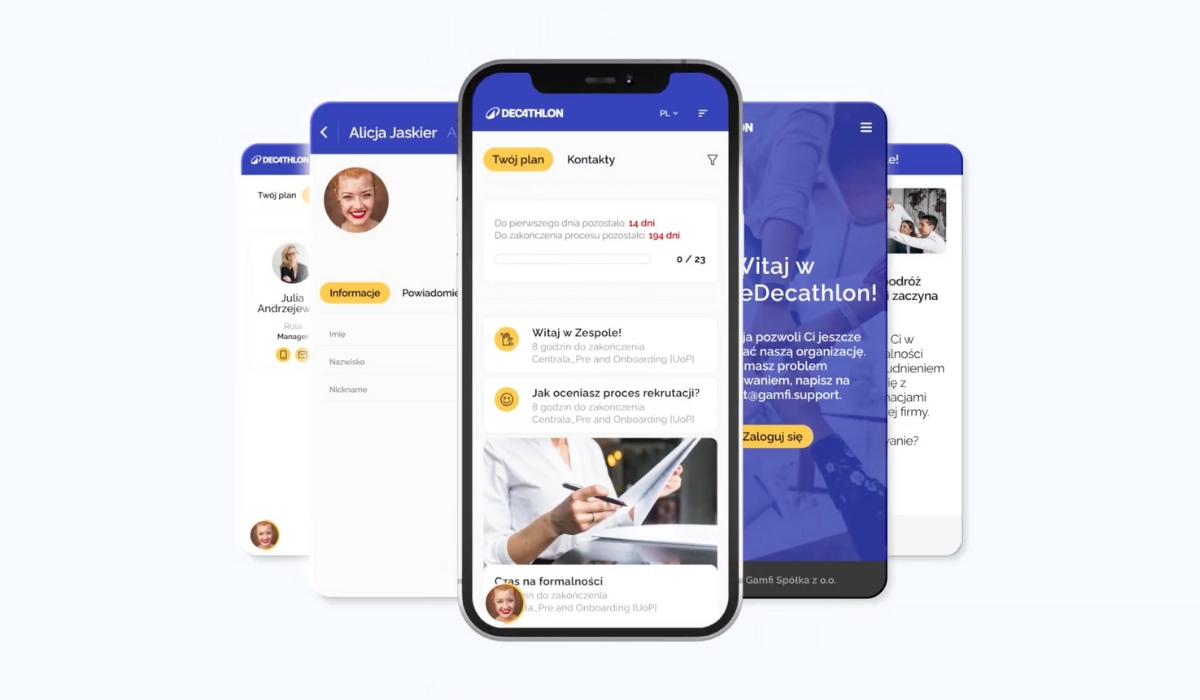
These criteria led the Polish HR team to rule out using the company onboarding app built at the French head office. After testing three different local solutions, the company chose the Gamfi onboarding platform, which met every criterion it had set.
Principles behind improving the onboarding process
Rolling out the Gamfi app was the engine of wider changes meant to put a new onboarding standard in place. For that change to work, it had to involve many different sides: alongside HR also managers, store leaders and sports advisers. The HR team worked out 6 basic principles to bring everyone involved to the same approach.
- One frameThe shared goal was to create a unified structure for all onboarding processes, with modules matched to the needs of specific roles, which gives clarity and consistency from the first days at work.
- Nothing about us without usOnboarding content has to be created by salespeople, managers, leaders and the individual teams, so that onboarding sits inside everyday work and reflects real challenges.
- Onboarding through doingOnboarding is to happen on the shop floor, which calls for many “on the job” tasks. They are what makes people settle into the role quickly and understand their impact on the business, and at the same time they fit the culture of an organisation that employs action-minded sportspeople.
- Say what matters from the startIn onboarding, business-critical information has to be passed on as early as possible: the rules of customer service, the logic of product display, the impact on results.
- The manager is responsible for feedbackThe onboarding platform supports the manager but does not do the work for them. It is the manager who has the main influence on the process and is the main support for a new person during onboarding, building their motivation and engagement through constant direct feedback, among other things.
- Tracking progress is the keyFeedback surveys available in Gamfi, triggered at different stages of onboarding, are meant to allow quick changes, to strengthen the engagement of everyone involved in onboarding and to give support at the key moments of the process.
Those principles became the “backbone” of the whole improvement effort and were communicated to everyone involved from the first meeting.
Stages of the change in onboarding at Decathlon
Onboarding is not a sprint, it is a marathon - that was the approach of the project group responsible for improving onboarding at Decathlon. The change was split into several phases, spread over several months and involving different groups of employees at different stages. The approach was iterative - the first process to be improved was the onboarding of sports advisers in the stores, covering the needs of 58% of everyone employed.
Process design phase
The HR team, together with representatives of every department from head office, mapped and designed a company-wide onboarding process. Each department pointed out the topics that mattered from its point of view for the sports adviser role, which turned into 7 topic areas covered by onboarding.
Verification phase
The process that came out of that was handed over to a project group made up of people in different roles working in the stores day to day. The group verified it, giving weight to the individual parts of the process, rejecting what was not relevant and adding their own changes.
Gamfi phase
The verified process, tidied up in an Excel file, was moved into the Gamfi onboarding platform. With support from the Gamfi support team, the HR team built the first onboarding path (a workflow) in the app.
Test phase
The Gamfi onboarding app with the first workflow was released for testing in selected stores - the ones where the biggest problems with onboarding and early turnover had been diagnosed. The app was tested by sports advisers, managers and store leaders.
Feedback phase
The people who ran the tests passed on their comments and suggestions about the process through an extensive survey in the Gamfi platform. Based on that feedback, the HR team corrected and optimised the onboarding path for advisers.
Kick-off across the whole organisation
The improved onboarding workflow went live across the whole organisation, covering everyone hired as a sports adviser regardless of location.
Once the first onboarding path was live, the HR team at Decathlon moved on to the next workflows: for the team manager, the operations leader and the store leader.
Sticking to the iterative approach, the HR team makes ongoing corrections to the existing process based on data from the Gamfi onboarding app. The first of the paths built for sports advisers is spread over more than 90 days. In version 2.0. it grew to more than 190 tasks assigned to four different roles taking part in the process.
Using the Gamfi onboarding app let us automate the repeatable part of the onboarding process. That took the HR team out of the role of process supervisor and at the same time brought value to the business. Today managers thank us for rolling out Gamfi, because the app makes their work more effective. Thanks to Gamfi the onboarding process runs in the background, sending automatic notifications about the steps coming up. As a result managers can focus on what really matters – on passing on their best knowledge exactly at the moment when a new employee needs it most.
Results of the rollout: business and HR measures
Within 12 months of putting the improved onboarding into practice, Decathlon recorded a measurable improvement in its indicators - both HR ones and business ones.
- by 10 pp
- (from 44% to 34%) fell the early turnover rate among sports advisers
- by 2.32%
- rose the sales conversion rate
- 77.95
- was the customer NPS (beating the target set by almost 2 points)
- 8.85
- out of 1–10 was the level of satisfaction with onboarding
In addition, poor onboarding became the least often given reason for leaving early of all the reasons raised in exit interviews.
Rolling out Gamfi fed directly into our business results, and that gave us the arguments to extend onboarding improvements across the whole organisation. Our goal is 100% of onboarding processes run in the Gamfi app.
Encouraged by the results of automating onboarding, Decathlon Poland is going a step further and starting a project to move offboarding processes into the Gamfi app.